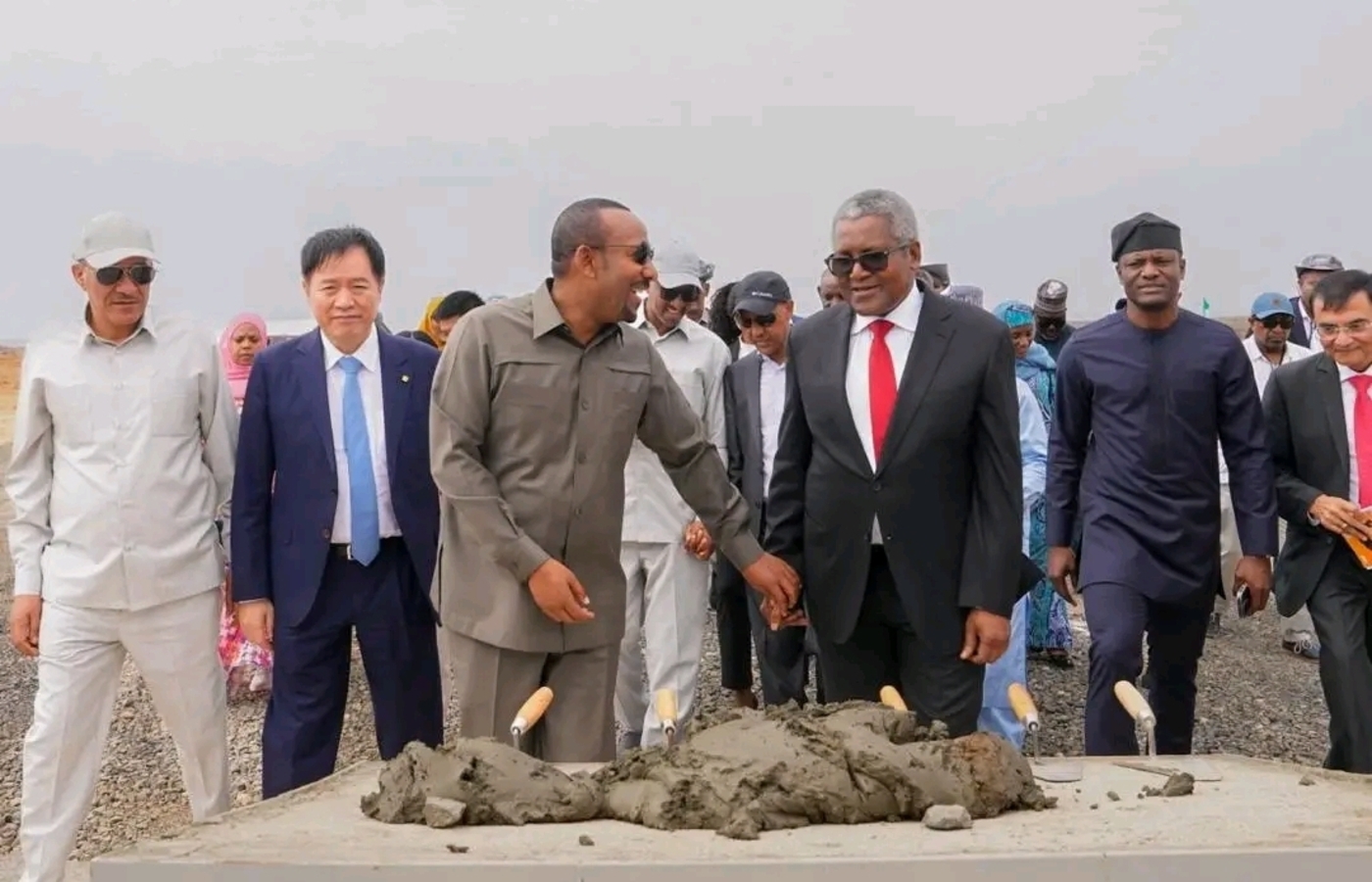
China’s Golden Concord Group (GCL) broke ground on October 2, 2025, on a $2.5 billion greenfield oil refinery in Gode, in Ethiopia’s Somali Regional State, making Ethiopia the last major African economy to acquire domestic refining capacity.
The facility is designed to process crude from the nearby Hilala field in the Ogaden Basin and produce 3.5 million metric tonnes of refined fuel annually across two construction phases. Prime Minister Abiy Ahmed described the project as “a milestone for Ethiopia’s industrial growth and energy security,” framing it as a direct response to the country’s long-standing dependence on imported petroleum.
The project carries consequences for Ethiopia’s foreign exchange position, for the architecture of Chinese energy infrastructure in East Africa, and for downstream fuel supply across a region that has historically depended on extended import chains. These dimensions warrant analytical attention for observers in the region and at-large.
Ethiopia’s Petroleum Import Dependency and the Foreign Exchange Burden
Ethiopia currently imports 100 percent of its refined petroleum products, spending approximately $4–5 billion USD annually on fuel, a sum that consistently exceeds the country’s total coffee export earnings. The Ethiopian Petroleum Supply Enterprise (EPSE) imported over 4.3 billion liters of petroleum products in fiscal year 2024/25, an 8 percent increase from the prior year, generating revenue of 457 billion birr against costs of 496 billion birr.
In October 2024, the National Bank of Ethiopia made an emergency $175 million allocation specifically for EPSE fuel payments as foreign exchange reserves fell below one month of import coverage. Industrial facilities operate at 50–60 percent capacity due to forex shortages, and fuel costs compound that constraint directly.
S&P Global estimates that a functional Gode refinery could meet approximately 70 percent of Ethiopia’s current fuel demand, generating foreign exchange savings that address the country’s most acute macroeconomic vulnerability.
China’s Integrated Downstream Strategy in Africa
The Gode refinery fits a consistent Chinese approach to energy infrastructure on the continent. CNPC, CNOOC, and GCL have pursued complete petroleum system construction across multiple African states, integrating upstream extraction, pipeline transport, refining, and distribution within single investment frameworks.
CNPC built a 100,000 barrel-per-day refinery at Khartoum alongside a 1,610-kilometer export pipeline and downstream petrochemical facilities in Sudan. In Niger, CNPC invested over $5 billion across the Agadem oilfield, the 20,000 barrel-per-day Soraz refinery, and the 1,950-kilometer Niger–Benin export pipeline. In Angola, China National Chemical Engineering is contracted to build the 200,000 barrel-per-day Lobito refinery, with Sonangol currently negotiating a $4.8 billion loan from Chinese financial institutions.
In the Horn of Africa, GCL’s ambitions extend beyond the refinery: in March 2026, Dangote Group and GCL signed a $4.2 billion, 25-year natural gas supply agreement to feed a fertilizer megaplant adjacent to the Gode refinery site, drawing on the Ogaden’s Calub gas field. This pattern of integrated investment creates durable dependencies on Chinese capital, engineering expertise, and operating systems, positioning Beijing for sustained structural influence over each of their host country’s energy sectors on the continent.
The Ogaden Basin: Reserve Potential and Security Constraints
The Ogaden Basin holds approximately 7 trillion cubic feet of independently verified natural gas reserves and associated liquids, but commercial-scale oil production remains undemonstrated. POLY-GCL’s 2018 test production at Hilala yielded 450 barrels per day, a fraction of the approximately 70,000 barrels per day the refinery requires at capacity.
Ethiopia’s total proven oil reserves stand at approximately 428,000 barrels, ranking 100th globally. Whether domestic crude can sustain refinery operations at commercial scale is the project’s most consequential unresolved variable.
The security environment compounds this uncertainty. The Ogaden National Liberation Front (ONLF) signed a peace agreement with the federal government in October 2018. However, in October 2024, the ONLF announced it was reassessing the agreement, citing fulfillment of only 20 percent of commitments on fighter reintegration and displaced community resettlement, and explicitly warned Chinese energy firms of repercussions.
The group’s stated precedent is the April 2007 Abole attack, in which ONLF forces struck a Sinopec-operated facility, killing 74 people including 9 Chinese workers. Unresolved political grievances in the area represent a material, documented risk to infrastructure operating in the basin.
Value Chain Development and the Regional Supply Architecture
The refinery’s analytical significance extends beyond Ethiopia’s domestic fuel balance. South Sudan, whose primary crude export pipeline through Sudan has been intermittently inoperable since Sudan’s civil war began in April 2023, has discussed with CNPC an alternative pipeline route through Ethiopia toward Djibouti.
Landlocked states across the Horn, including Uganda and multiple Intergovernmental Authority of Development (IGAD) members, depend on extended refined-product supply chains that impose material cost premiums on consumer fuel prices and industrial inputs. A functioning Ethiopian refinery could supply these markets, generating export revenue while consolidating Addis Ababa’s position as a regional energy distribution center. Africa currently imports over 70 percent of its refined petroleum products despite holding approximately 125 billion barrels of proven crude reserves, spending an estimated $30 billion annually on those imports.
Ethiopia’s geographic position at the intersection of multiple landlocked supply deficits gives the Gode facility a regional market rationale that is independent of its domestic energy security function.
Outlook
The Gode refinery’s trajectory will be shaped by three variables: the commercial viability of Hilala crude at the volumes the facility requires, the stability of the security environment in the Somali Regional State, and the structure of the GCL-Ethiopia financing arrangement, which has not been publicly disclosed. POLY-GCL’s decade of repeated production delays on the original Ogaden gas export pipeline, which the Ethiopian government formally cancelled in June 2025 after persistent financing failures, establishes a relevant historical baseline against which the refinery’s construction timeline should be assessed.
The March 2026 Dangote-GCL gas supply agreement suggests active operational momentum in the adjacent fertilizer project, and that momentum may benefit the refinery’s development. What is structurally clear is that Ethiopia’s petroleum import dependency creates an economic imperative for domestic refining capacity that no prior investment has successfully addressed. Whether GCL delivers where previous investors did not will determine whether the Gode refinery becomes a foundation for industrial value chain development in the Horn of Africa or extends the Ogaden Basin’s long record of deferred economic potential and promise.
About an Author
Arman Sidhu is an American geopolitical analyst and writer. He regularly covers the commodities market, international trade and foreign investment. He is a regular contributor to Geopolitical Monitor and his work has previously appeared in The Diplomat, Eurasia Review, Economic & Political Weekly, and RealClearWorld, among several other outlets. The views expressed in this article are the author’s own.