Let South Africa become a role model for a more just and humane world of the future. If you can make it, all of us can.
—Fidel Castro Ruz.
Capetown, South Africa. September 4, 1998
If they do not speak, will stones?
The structural inequality that defines contemporary South African society requires no specialised academic apparatus to dissect; its manifestations are sufficiently vivid to be apprehended through sensory experience alone. Within the territorial boundaries of the nation-state, multiple social realities coexist, each masquerading beneath the fictitious myth of the “rainbow nation”—the ideological construct that posits the dwellers of affluent Sandton and wretched Alexandra as unified in their diversity.1
When South Africans articulate grievances concerning violence, criminality, unemployment, landlessness, inadequate health services, extreme poverty, food insecurity, and systematic underpayment across production and service sectors, the scholarly community must attend with rigour. One must resist the temptation to be seduced by Johannesburg’s skyscrapers, Durban’s beaches, or Cape Town’s fashionable apartments—a seduction that might otherwise lead to the erroneous presumption that South Africans demand excessive concessions.2
One confronts a society in which, a mere three decades prior, indignity was constitutionally enshrined, and in which far too little has been accomplished to dismantle the foundational structures that rendered such a constitutional order possible, beyond the mere erasure of certain written clauses.
The Unfinished Business of Liberation
The dismantling of apartheid legislation demanded the sacrifice of hundreds of thousands of lives and the mobilisation of a global anti-apartheid movement. The white minority demonstrated its preparedness to unleash nuclear Armageddon in defence of the status quo. Hundreds of thousands were compelled to flee, whilst the millions who remained were subjected to one of the most vicious regimes in human history—a regime that received consistent backing from powerful Western imperialist nations throughout its existence.
The negotiated settlement produced profoundly uneven concessions. Black South Africans were politically integrated, yet economically and systematically negated. Resources expropriated from them, predominantly through violence, were never adequately compensated. Persistent pressure was mounted upon the black majority government to demonstrate their capacity to secure prosperity, predicated upon the spurious assumption that they now possessed all requisite political power—an argument fundamentally untenable. As Winnie Mandela astutely observed, “The African National Congress(ANC) are in the government, but they are far from being in power.”
Consequently, the global anti-apartheid struggle ought never to have been demobilised, for apartheid is not reducible to the “Blankes” and “Nie-Blankes” billboards that once demarcated public space; it is fundamentally concerned with ownership and control over the creation and distribution of wealth. The economic opportunities available in contemporary South Africa continue to echo this philosophy, substantiating the legitimacy of the majority’s outcry—the cries of Kennedy Road’s shack dwellers in Durban and Vanrhynsdorp’s farmworkers in the Western Cape.
The Political Economy of Land and Labour
South African econometrics illustrates this reality with stark clarity. The question of land ownership—conventionally understood as the principal means of economic production—reveals that merely 14–23 per cent of South African land is state-owned, whilst 77–79 per cent is held privately, and 6–7 per cent remains undocumented. Among private landowners, 72 per cent are South Africans of European stock (whites), who constitute only a small fraction of the national population. The remainder is purportedly distributed among the vast majority: coloured South Africans own 15 per cent, Indian South Africans 4 per cent, and black South Africans a mere 5 per cent, despite constituting 82 per cent of the population. This configuration suggests that the majority of black South Africans possess no territory they can rightfully or legally claim as their own.3
Among the manifold legislative instruments that shaped South Africa’s economic relations, the Native Land Act of 1913 and the Native Trust and Land Act of 1936 have proven most consequential. These statutes effected the massive alienation of black people from the land and served as the critical genesis of the systemic, forced proletariat class, the shop-floor slaves, and the consolidation of de-peasantisation—the institutionalisation of farm-work labouring.4
In the commanding heights of the economy—production industries, mining, and the service sector—skin colour has remained a qualifying determinant. A substantial percentage of South Africa’s GDP derives from economic activities owned by South Africans of European stock and Western-owned multinational corporations. Between 70 and 80 per cent of all major corporations remain in white and foreign hands. As of 2022, not a single Johannesburg Stock Exchange (JSE)-listed company was fully black-owned. Black ownership in JSE-listed companies averaged approximately 30 per cent under Broad-Based Black Economic Empowerment (BBBEE) measurements.
The national unemployment rate stands at approximately 40 per cent, whilst youth unemployment hovers closer to 70 per cent, with the majority of the unemployed being black South Africans. These factors contribute primarily to maintaining the majority of black South Africans in structural immiseration. It is from these conditions that the architecture of inequality is fortified, and hardship becomes structurally guaranteed. Scapegoating—the most fertile seed of fascism—hatches readily in such conditions, for there is no discernible light at the end of the tunnel. The enemy becomes an immediate but weaker “non-you” folk, notwithstanding the shared similarities between the two underprivileged groups.
Most importantly, it would be absurd and insulting to allege that laziness constitutes the cause of the plight of black South Africans. If any labour has advanced the productive force of South Africa, it is the labour of black South Africans. From the enslavement and pogroms across the Cape in the seventeenth century to the Marikana massacre of the twenty-first century, it has been the blood of black South Africans that has been predominantly spilled. One ought not to mimic the narratives of oppressors in comprehending the experiences of the oppressed.5 Was this not the same narrative propagated during the epoch of classical racism by European conquerors?
The Dimensions of the Migration Plight
As Julius Nyerere trenchantly observed, “Discrimination is like consuming human flesh. Once you start, you never stop.” The lion’s share of wealth produced in South Africa is owned and controlled by migrants, descendants of migrants, and the global bourgeois class—but assuredly not Afro-migrants, not even Asiatic migrants, who have historically been positioned as a buffer between the white minority and the remainder of the population.
Contemporary Afro-migration to South Africa is not the migration of “conquerors” but of the “conquered.” Mine workers, farm workers, and construction workers from already colonised societies of the region and beyond have made their exodus to South Africa in significant numbers, in their quest for a better life after having been alienated from their primary means of sustenance—the land—and from whatever consequences flowed from its subjugation.6
As far north as the northern reaches of Southern Africa, labour was extracted to exhaust wealth production in South Africa, particularly from the eve of the nineteenth century through to the Second World War. The British Empire, through its bandits—erroneously designated “explorers” in the colonial historiographical tradition—and certain philanthropists, bears responsibility for the reconfiguration of the entire economic dimensions of the Southern African region to the detriment of its indigenous populations, notwithstanding the Portuguese and Dutch presence in that same region for nearly two centuries prior to the British conquest.
Hence, the contemporary question of migration is intimately tied to capitalist production development and its magnetic induction. It is a system that permitted minority migrants from Europe to dispossess indigenous populations of their land and sever them completely from ownership and control of the wealth produced, and from the means of economic production. It is a system that brought in Afro-migrants, as the renowned Hugh Masekela alluded to in his celebrated composition “Stimela.” It is a system that has casualised labour so extensively through austerity and neoliberal prescriptions, leading to the devastation of labour’s leverage to negotiate working people’s interests, or to overthrow capitalism altogether.
As a system, it seeks to asphyxiate Afro-migrants and other working people from disarticulated economies migrating to South Africa, whilst simultaneously suffocating South African working people’s bargaining power against white monopoly capital. It is capable of generating animosity between two groups of working people, rather than against the system that produces such conditions, particularly when the two groups of workers fail to converge in solidarity against it.
In South Africa, it is estimated that there are more than three million documented migrants, the majority hailing from the Southern African Development Community (SADC) countries. The majority of migrants, including the undocumented, are engaged in the informal sector, ranging from farm working to street vending and courier services. Others own modest properties, largely in the service sector. There are, undoubtedly, migrants engaging in illicit activities and crimes ranging from armed robbery to narcotics trafficking, fraud, and sundry other offences.
However, clarity must be maintained: migrant-reported crimes constitute part and parcel of the wider South African crime issue, largely enabled by internal elements, including within the South African security apparatus. South Africa maintains 240 correctional facilities, and the majority of convicts—over 140,000 out of 167,000 prisoners—are not migrants, in stark contrast to the insistence of xenophobic elements who attempt to attribute criminality to migrants.
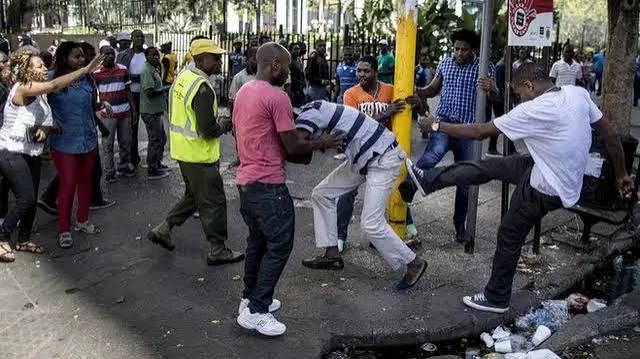
All concerned parties ought to refuse to remain passive in this situation, in which horrendous ramifications may be forecasted. The escalatory messages and instigations disseminated on digital platforms further poison an already tense atmosphere. The “black-on-black” violence that characterised South Africa during the 1990s should serve as a salutary reminder that little can be achieved by targeting Afro-migrants, whether documented or undocumented. Each time the forces of reckoning—the working people’s formations, organised or otherwise—misdirect their target, the system that produces all these maladies is granted time to recuperate, rearm, and consolidate itself for future offensives.
With regard to criminology in South Africa, the recent Mkhwanazi Inquiry, encompassing the Political Killings Task Team (PKTT) revelations unpacked by Lieutenant General Nhlanhla Mkhwanazi, should command the attention and righteous indignation of every South African and every concerned observer, particularly insofar as we grapple with the question of the role of security forces in the migration issue. The Swahili people possess a proverb of profound wisdom: “It is the man [or woman] who is a witch; owls and cats are merely instruments.”
Geopolitical Front: External Pressures and Internal Vulnerabilities
The world is undergoing rapid transformation. The liberal order that has moulded the globe is being heavily challenged and depleted. It has become increasingly difficult for the collective West to replenish itself. Its current hegemon, the United States, can only sustain its cultural and military might, rather than its erstwhile economic dominance. Serious contenders are emerging across the globe, and South Africa is considered to belong in that camp.
Yet South Africa is irreducibly African. As a state, it was crafted in the crucible of colonialism with the objective not of building a nation, but of facilitating exploitation without friction among colonial powers. Just as in many other African countries, post-apartheid South Africa constitutes a fusion of many nations—African and European tribes, as well as Asian communities—all possessing a reasonable degree of autonomy and distinctive identity, and sometimes divergent aspirations.
As an emerging power with an anti-imperialist posture, South Africa invites pressure from imperialist powers. There is, of course, no plausible pretext[so far] for military intervention in South Africa by the United States, as has been the case with Iran and Venezuela. However, hybrid warfare against South Africa has been waged on various fronts. South Africa’s recent insubordination towards the United States and its unwavering support for the Palestinian cause—including its suit against Israel before the International Court of Justice (ICJ)—do not sit well with the United States, and certainly not with Zionist Israel.
One of the South Africa’s strategic choke points is national cohesion. From the era of orchestrated “Bantustans,” whoever wishes to undermine South Africa as a nation would understand that the loyalty hierarchy in South Africa remains strongest at the level of tribal ethnicity, followed by race, and only lastly to the republic. This configuration functioned during the colonial and apartheid era; indeed, even within the ranks of the liberation movements, the malignancy was not less severe.
It may be difficult to establish a direct link between the anti-migrant movement and Zionist or imperialist machinations, but it would be equally imprudent to assume that Zionist and imperialist forces are not interested in such developments, or that the anti-migrant issue is somehow separable from the trajectory of global events. Anti-migrant demonstrators, or their sympathisers, have been observed parroting the “Make South Africa Great Again” slogan, borrowing from the MAGA movement in the United States, just as Shah Pahlavi’s followers have chanted “Make Iran Great Again” across Western capitals. For as long as the anti-migrant movement provides scope to deflect South Africa from functioning as a lethal anti-Zionist and anti-imperialist force, South Africa’s adversaries will always be interested in endorsing, if not actively facilitating, it.
When one observes tribal kings being honoured by Tel Aviv—such as AbaThembu King Buyelekhaya Zwelibanzi Dalindyebo’s visit to Israel, organised by the Israeli Foreign Ministry, where he met with Isaac Herzog and Gideon Saar, the President and Foreign Minister of the State of Israel—one must pay close attention. During his tour, King Dalindyebo visited communities affected by the tragic attacks of 7 October 2023, and met with survivors and families of hostages. Of course, he was not taken to Rafah, Khan Younis, or Gaza City to witness the genocide and the carpet bombing of everything in its path, and thereby to comprehend why his country possessed a strong case to present before the ICJ. The objective was that the King should have a story to tell his subjects—the AbaThembu people—and that story should be Israel’s story.
During approximately the same period, President Ramaphosa visited the United States and was humiliated by his host in the Oval Office, who accused South Africa of unfounded allegations such as “genocide against white South African farmers.” It was all by design. The pressure exerted was intended to intimidate the South African government from embarking upon a meaningful agrarian revolution that commences with land redistribution. And this pressure has its origins from within South Africa itself, particularly through white lobbyist entities such as AfriForum.
It is imperative that there be further exploration of the patterns of anti-migrant waves. In striving to do so, one does not become alarmist, knowing fully well that those who are interested in a disintegrated South Africa were the allies and benefactors of the evil apartheid regime. The South African socio-political-economic conditions render it possible for Zionist-linked groups such as South Africans for Israel (SAFI) and the South African Zionist Federation (SAZF), as well as other divisive racist organisations like AfriForum, to identify and hijack vulnerable groups and individuals to advance their interests—interests that frequently include further weakening social cohesion, thereby destabilising the South African state and preventing it from holding them accountable.
Reclaiming Pan-African Future
“Sipuma sangena kwa manyamazwe, Spho kughazi konu, Baba na uMama, Salel nkhululekho.”
A South African liberation struggle song
One of the principal strategies of xenophobia and Afrophobia formations has been historical revisionism. Some have gone so far as to discredit and ridicule Pan-Africanism as an obsolete and meaningless ideology, founded by Africans from the diaspora, whom they claim possessed little or no knowledge of continental Africa’s realities and epistimologies. Some are dismissing the relevance of continental solidarity’s contributions to South Africa’s milestones—securing the expansive liberal space it presently enjoys—solely to justify the claim that South Africans owe nothing to anyone.
Certain xenophobes constantly cite tragic incidents involving specific African governments that maintained a conciliatory stance against the apartheid rogue regime, whilst deliberately omitting to highlight the stories of other Africans whose blood was spilled for the liberation of South Africa from apartheid, both combatants and non-combatants. Arguably, the anti-apartheid struggle is the one that brought global African people closer together in solidarity, second to none. Yet there are those who believe we should dismiss it, simply because South African law enforcement has been deficient in upholding its mandate.
The apartheid military machine exported its destructive force far beyond South Africa’s borders, reaching as far as Tanzania. One may readily imagine what they were doing in Mozambique, Zambia, Lesotho, Eswatini, Angola, Botswana, and in Namibia, where they were occupying it as a colonial power. All these countries were attacked for no reason other than harbouring, training, and facilitating South African freedom fighters, refugees, and other personnel. Zambia, Mozambique, and Zimbabwe, exempli gratia, faced economic sabotage, some of which took decades to mitigate. Economic embargoes were imposed, civilian infrastructure destroyed, and human lives lost, but the general enduring commitment was that, unless every African was free from colonialism and white-minority rule, no African was free.
For as long as the gains made during the freedom struggle were the product of collective work and solidarity, then the discourse of migrants’ expulsions by citing reasons such as “they have failed to fix their countries” becomes irrelevant, as per the spirit of the collective approach to our problems. Why should it be a matter of debate that, within South Africa’s borders, it is the responsibility of South African law enforcement to apprehend those who are not complying with migration laws or any other laws, non-South Africans and South Africans alike?
It would be absurd not to acknowledge that it is expected that Zimbabweans should always be on the frontline of resolving the plight that faces Zimbabwe. But what, precisely, is the plight that faces Zimbabwe? If Zimbabwe is being punished for returning the land to the original owners who were forcefully expropriated through colonisation, how is that not a South African or Kenyan issue, as countries with similar or identical land plights?7
What did Africa do when the collective West was destroying Zimbabwe and Libya? Some countries were co-opted into the Western discourse that justified the strangulation of Zimbabwe and Libya. Butu who is pleased with the ramifications that those invasions unfolded?
The politics within our countries needs to be integrated in a manner that is liberational and resistant to foreign interference and meddling. In the SADC region, for example, solidarity has been exercised by former liberation movements to shield one another from electoral rigging and the state violence that states unleash predominantly against the subalterns of those countries. The best cases to cite would be Zimbabwe (ZANU-PF), Mozambique (FRELIMO), and now Tanzania (CCM).8
If our politics should enable us to hold one another accountable as countries and shield one another from real threats, they must simultaneously capacitate the integration of our economic potentials. Our economies must be integrated in terms of beneficiation and collective strategic economic interest protection. Collective efforts to mitigate transborder illicit economic activities are imperative. There are numerous back channels where cartels smuggle resources worth billions in almost every region of the continent, from minerals to forestry products. There must be concrete collective efforts to combat this vigorously in order to maximise the value of our economic products and activities. This should include the issue of capital flight. According to the African Development Bank (AfDB), Africa loses over 587 billion dollars annually—almost half of the continent’s GDP—to capital flight, driven by corruption and illicit flows, whilst external capital inflows totalled a mere 190.7 billion dollars.9
In the case of South Africa’s migration question, leadership is what is required, and so it is in the rest of the African continent. It is normal procedure for undocumented migrants to be deported, and undocumented migration needs to be legally discouraged for obvious reasons, for as long as Africa continues to adhere to the African Union and United Nations charters. But it is far more dangerous to sow the seeds of hatred, as some leaders of the anti-migrant movement have alluded that they cannot guarantee the security of migrants post-June 2025.
Lest we forget or overlook, the ruling class and the African bourgeois class are well integrated in securing their interests. We all know, for example, that whilst an ordinary South African might have grievances with a Congolese from Kivu, the South African bourgeoisie maintains cordial relations with the Congolese bourgeoisie and government in the mining sector. It is no wonder that wherever there is gold and platinum, there is also Barrick and Lonmin.10
Hence, it is African people, particularly the subalterns, who are responsible for changing the equation—organising around concrete issues, under concrete strategy, and in solidarity. Here, one should consider the organised and unorganised movements, the youth movement, and the social movement. This is the force to be built: the force to overthrow both the bourgeoisie—such as white monopoly capitalism—and the compromised, compradorian regimes.11
Chauvinistic nationalism, toxic patriotism, and parochial ethno-maniacism can only bring danger and waste upon us for yet another century.
The socialisation of the South African economy is the only meaningful solution to South Africa’s economic difficulties. South Africans, the majority black, cannot afford to deviate from that objective to a scrape-economy. The war with migrants is indeed the war over leftovers.
About an Author
Muhemsi Mwakihwelo is a Tanzanian political analyst, Writer, and Pan-African thinker whose work focuses on anti-imperialism, African sovereignty, and global power structures.
The views expressed in this article are the author’s own.
Endnotes
1. Nigel Gibson, review of Fanonian Practices in South Africa: From Steve Biko to Abahlali BaseMjondolo, by M. Mawere, Strategic Review for Southern Africa 36, no. 1 (2020), doi:10.35293/SRSA.V36I1.159.
2. Guy Lamb, “Violent Crime in South Africa Happens Mostly in a Few Hotspots: Police Resources Should Focus Here—Criminologist,” The Conversation, February 5, 2025, https://theconversation.com/violent-crime-in-south-africa-happens-mostly-in-a-few-hotspots-police-resources-should-focus-there-criminologist-248233.
3. Department of Rural Development and Land Reform, “Phase II: Private Land Ownership by Race, Gender and Nationality,” November 2017.
4. South African History Online, “The Natives Land Act of 1913,” March 6, 2013, https://sahistory.org.za/article/natives-land-act-1913.
5. Judith Hayem, “Marikana: Analysing Miners’ Subjectivity and the Crisis of Representation,” Journal of Asian and African Studies 51 (2016): 171–85.
6. Mahmood Mamdani, Citizen and Subject: Contemporary Africa and the Legacy of Late Colonialism (Princeton: Princeton University Press, 1996), https://doi.org/10.2307/j.ctvc77c7w.
7. Sam Moyo, “The Political Economy of Land Acquisition and Redistribution in Zimbabwe, 1990–1999,” Journal of Southern African Studies 26, no. 1 (2000): 5–28, http://www.jstor.org/stable/2637547.
8. United Nations, “Tanzania: Reports of Hundreds Killed and Detained Following Deadly Election Violence,” UN News, November 11, 2025, https://news.un.org/en/story/2025/11/1166334.
9. Léonce Ndikumana and James K. Boyce, “Capital Flight from sub-Saharan Africa: Linkages with External Borrowing and Policy Options,” International Review of Applied Economics 25, no. 2 (2011): 149–70, doi:10.1080/02692171.2010.483468.
10. Issa G. Shivji and Godwin R. Murunga, Where Is Uhuru? Reflections on the Struggle for Democracy in Africa (Oxford: Pambazuka Press; E&D Vision Publishing, 2009).
11. Michael Neocosmos, “Constructing the Domain of Freedom: Thinking Politics at a Distance from the State,” Journal of Contemporary African Studies 34, no. 3 (2016): 332–47, doi:10.1080/02589001.2016.1236876.